
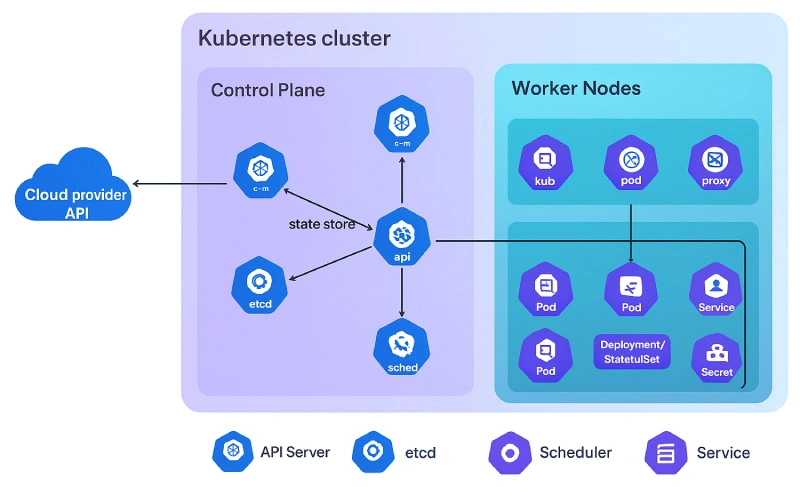
Kubernetes is a powerful and highly sophisticated container orchestration platform. While this tutorial will not delve into the full operational complexities of maintaining production-grade Kubernetes clusters, it is important to establish a solid understanding of the fundamental and advanced concepts that influence an effective WordPress deployment on Kubernetes.
Do not worry if every concept does not immediately make sense, each of these components will be explored in much greater depth throughout the upcoming sections, supported by practical examples and detailed explanations. The goal of this overview is simply to provide a high-level understanding of the Kubernetes architecture.
Nodes
A Kubernetes cluster is composed of one or more worker nodes. These nodes are physical or virtual machines connected through a network and running core Kubernetes services along with supporting software, enabling them to participate in the cluster. Nodes can be dynamically added or removed, allowing the cluster to scale and adapt as needed.
Pods
A Pod is the smallest deployable unit in Kubernetes. Each pod contains one or more containers along with their configuration, including resource requirements such as CPU, memory, and storage. Nearly every workload in Kubernetes — including many internal system components (DNS, API server, networking services, and more) — runs inside pods.
Although it’s possible to create and manage pods directly, Kubernetes provides higher-level abstractions that offer improved scheduling, scaling, and lifecycle management. When deploying WordPress, we will begin with a single pod, and later transition to using Deployments and StatefulSets for better control and reliability.
Deployments and StatefulSets
A Deployment defines how a set of pods should be created, managed, scaled, and updated. It is ideal for stateless applications, providing seamless rollouts, rollbacks, and automated scaling. However, since WordPress relies heavily on persistent data, Deployments may not always be the best fit for all components of the setup.
A StatefulSet is similar to a deployment but is designed for workloads that require stable network identities, predictable pod names, and persistent storage. StatefulSets ensure ordered deployments, controlled scaling, and consistent identities — making them well-suited for stateful components of a WordPress environment.
Services
Although pods can communicate over the cluster network, their IP addresses are dynamic and can change as pods are recreated. A Service provides a stable IP address and DNS name for one or more pods, automatically tracking any changes in the underlying pod IPs.
Services can also distribute traffic across multiple pods and enable external access to applications. Throughout this tutorial, we will explore best practices for exposing WordPress workloads and load balancing traffic within the cluster.
ConfigMaps and Secrets
ConfigMaps and Secrets are simple key-value stores used to supply configuration data to pods. ConfigMaps typically hold non-sensitive configuration, while Secrets store sensitive information such as API credentials, database passwords, or TLS certificates.
Both can inject data into containers as environment variables or mounted files, making them ideal for providing custom configuration to components like Nginx, PHP-FPM, or WordPress itself.
Summary
In summary, a Kubernetes cluster is composed of Worker Nodes that run Pods, which in turn run application containers. Pods are typically managed through Deployments or StatefulSets, exposed through Services, and configured using ConfigMaps and Secrets.
Although these concepts may feel complex at first, they lay the foundation for understanding the architectural choices we will make as we distribute a WordPress application across a Kubernetes cluster.
In the next section, we’ll walk you through creating your first Kubernetes cluster.


Leave a Reply